Amar é querer possuir o outro sem algemas, e falhar. Sartre estava certo: o inferno são os outros, e o amor é sua porta de entrada. Eu tentei amar. Não por virtude, mas por vertigem. Acreditei, por um instante patético, que o amor poderia ser um lugar de repouso. Mas o amor não é descanso, é vigília. É ansiedade de controle disfarçada de entrega. É a tentativa insana de capturar a liberdade do outro e de sufocar a nossa em troca. No fundo, amar alguém é desejar que o outro nos veja como insubstituíveis, que escolha a nós não por acaso, mas por destino. Mas não há destino. Só escolhas. E cada escolha do outro é uma ameaça à nossa ilusão. Cada olhar que ele lança ao mundo que não somos nós, cada silêncio que não conseguimos interpretar, cada recuo é uma traição. Porque amar é esperar, e esperar é dar poder ao outro.
O amor, então, se torna uma guerra de vontades.
Tentamos possuir o olhar do outro, congelar sua liberdade, transformá-lo em reflexo. Mas a liberdade escapa. O outro é sempre outro. Um estrangeiro. Um buraco negro onde projetamos nossas carências.
Sartre disse: “Amar é querer ser amado.” Ou seja, amar é um pedido, e todo pedido carrega humilhação. O amor nos coloca de joelhos, mesmo quando tentamos parecer grandiosos. Mesmo quando dizemos: “te amo”, o que queremos dizer é: “Me torna necessário. Me dá um lugar. Me inventa um sentido.” Mas não há sentido. Só o vazio entre dois corpos tentando se convencer de que o toque suspende o absurdo.
E então me pergunto: vale a pena amar as pessoas?
Não. Amar é se tornar escravo de uma liberdade que não podemos controlar. É desejar ser tudo para alguém que continua sendo mundo demais para caber na nossa esperança. É construir castelos em pântanos com a certeza de que vão afundar. O amor não salva. O amor apenas nos mostra o quanto estamos dispostos a sofrer para não encarar o nada.
Seeing the world how it truly is, without myth, without filter, without purpose, is not awakening. It’s mutilation. It’s like scraping the cornea of the soul against the edge of every street, every face, every billboard that still pretends there’s something worth hoping for. I’ve looked too long. I’ve stared into the mechanics of daily life, into the rituals and performances, into the forced laughter and practiced grief, and all I see is a species too aware to be innocent, too broken to be divine. And I am punished for seeing. Punished with memory. Punished with awareness. Punished with a tongue that still moves in a world that’s already gone sour.
Clarity doesn’t elevate. It erodes. It strips you of the polite lies you once needed to keep moving. It shows you that kindness is currency. That joy is branding. That everything you were told to strive for smells of metal, piss, and performance the closer you get to it. Love is a market. Morality a costume. Even silence has been monetized. Even death feels performative now. To feel all of this is to rot before your body does. To truly perceive the world is to carry an infection of knowing slow, invisible, terminal. And so we turn to numbness, because we know. We take the pills. We scroll. We stare at glowing rectangles. We pretend to care about what others eat, fuck, fear. We let the noise in, because the noise muffles the edge. Numbness is a tourniquet on the soul. Numbness is the seatbelt for the crash we call waking up. Numbness is survival, bitter and barely working, but more honest than hope.
We shouldn’t be feeling this much.
Only man, this atrocity of cognition, stares into the raw pulp of the real and dares to name it meaningful. I reject that, i choose the static, the blindfold, i choose whatever the drug dulls shriek of knowing. Because to feel everything is to die screaming. And I’ve already screamed too much
They tell you fire is an end. A purification. A closure. But that’s a lie spoken by the living, to soothe the unbearable thought that something remains. Fire doesn’t erase. It translates. Fire is not a destroyer, it is an interpreter, a violent linguist, fluent in flesh. Every pore, every scar, every stitch of human contradiction is rewritten in flame, rendered into a language we pretend not to know: ash.
When the body enters the furnace, it does not simply burn. It speaks. Skin contracts, curling inward like regret. Eyes boil from remembering. The tongue, that last traitor, blackens into silence. But the ribs creak, as if the body resists, as if some residue of identity arches up against the inevitability of interpretation. The bones do not surrender easily. They split like syntax breaking under pressure. The heart, that mythic thing, bursts quietly, as if finally understanding it was never more than a hot knot of muscle.
You think you’re watching, safe behind glass. But if you look long enough, you begin to feel the fire inside you. You begin to sense the translation reaching for your own skin, as though proximity alone invites vocabulary into your bones. The smoke rising from the chimney isn’t release. It’s lexical. Each plume carries phonemes of memory, vaporized truth, names that once meant something. You scatter ashes in fields, at sea, under trees but you never ask what the ashes do with you.
Because ash is not inert. Ash is thought without shape. And when it clings to your fingers, to your breath, to the folds of your lungs, you begin to dream things that were never yours. Memories take root in your sleep like black spores. You speak in languages no one taught you. You say names no one remembers. And when you light a match, your body pulses, almost in reverence.
Cremation, you realize, was never about ending. It was a beginning too vast to control. Fire translates the flesh into dust, yes. But dust is not silence. Dust is the book written after the body ends. Dust is the voice that survives the scream. And fire, that divine linguist, doesn’t ask for permission. It reads you as you are imperfect, afraid, unfinished and gives you back in fragments. Somewhere in that smoke, the body still dreams. And someone else is breathing it in.
There are places on this planet where life does not thrive, because was never welcome. These are not barren wastelands in the conventional sense, but geological refusals. Zones of negation. Pockets of the Earth where biology is not merely absent, but actively repelled. Here, the mechanisms that sustain all that is living, sunlight, moisture, breath are corrupted, inverted, or altogether missing. These are places where chemosynthesis, that obscure alternative to photosynthesis, fails not for lack of chemicals, but for lack of will. The Earth, in these wounds, does not wish to generate. It wishes only to endure in silence.
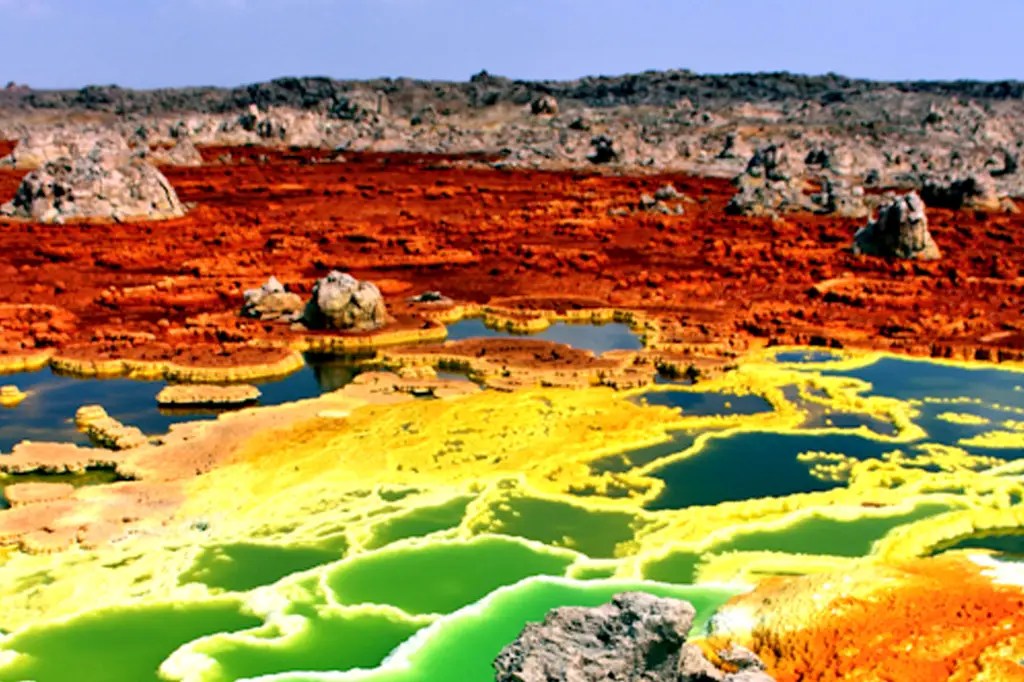
In Dallol, Ethiopia, the crust splits open into kaleidoscopic pools of acid and salt. Temperatures soar beyond the point of tolerance, and the pH sinks close to zero. The atmosphere is laced with sulfur, chlorine, and iron. The terrain, though vibrant in hue, is dead. Some scientists argue over the presence of microbial life, but even if it exists, it does so in a state of perpetual siege, an existence without comfort, without reprieve. Dallol is a furnace of color where even extremophiles blanch.
Dallol, Ethiopia
In Montana, the Berkeley Pit yawns like a failed alchemical vessel. Once a copper mine, it is now a lake of sulfuric acid and heavy metals. The water stopped reflecting the sky, it now devours it. Birds that mistake its surface for rest are poisoned mid-flight. The lake is inhospitable to fish, insects, algae, hope. It is a still, rust-colored mouth whispering death.
Berkeley Pit
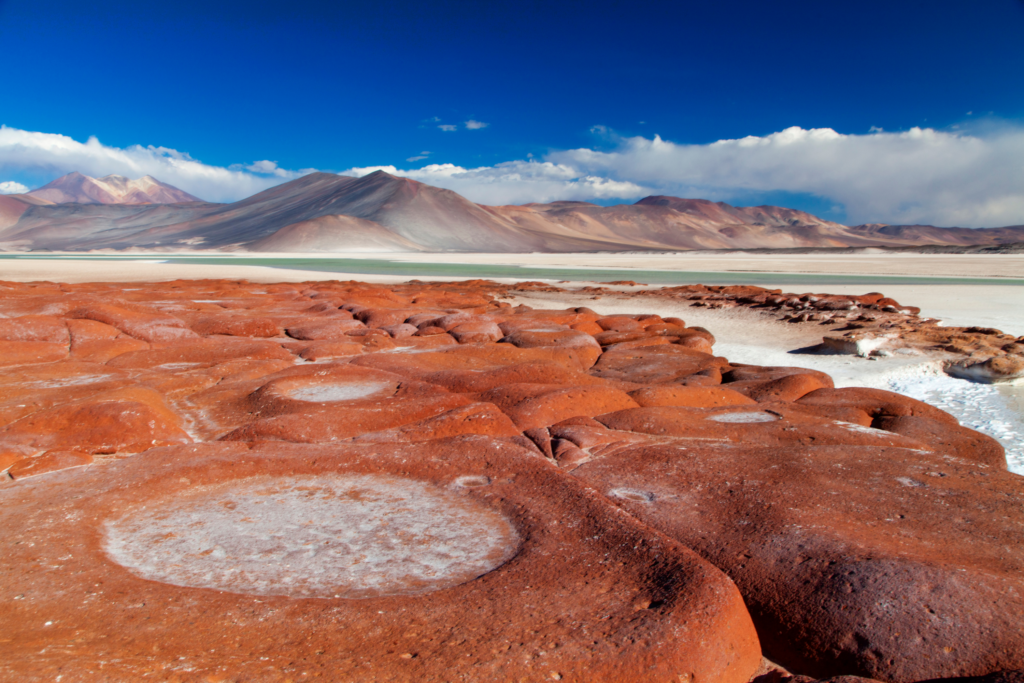
Farther south, the Atacama Desert sprawls across northern Chile like an exiled skin. Some regions have never known rainfall in human memory. Soil samples pulled from its driest veins return sterile devoid of visible life. It goes utterly lifeless at the microbial level. Even the air feels evacuated. NASA tests Mars rovers there. It is a preview of planetary sterility.
Atacama Desert
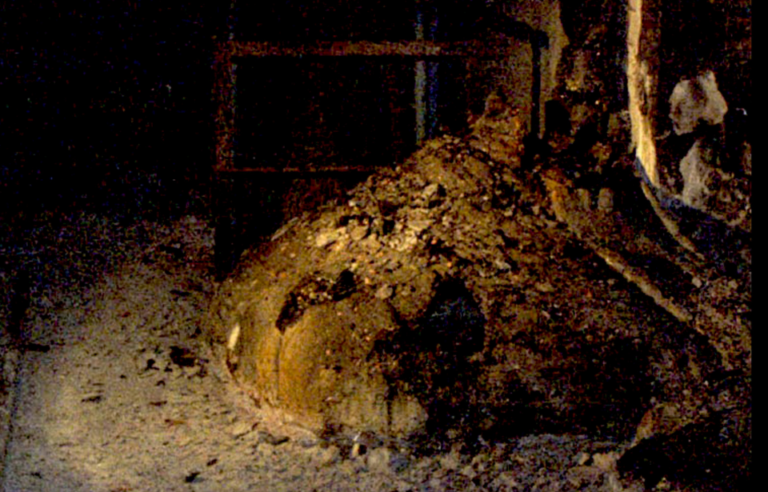
Then there is the Elephant’s Foot, deep within the sarcophagus of Chernobyl. A congealed mass of uranium, sand, graphite, and steel. It is not a natural feature… it is a mineral born of catastrophe, a creation of human failure. For years, its radiation was so intense that merely standing near it meant certain death. Today, the dose has waned, but no organism dares colonize its vicinity. It is a relic of unlife.
Elephant’s Foot
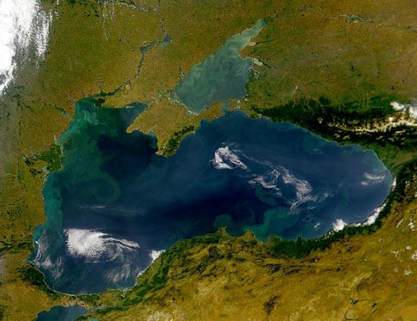
In the Black Sea, below a certain depth, oxygen vanishes. Replaced by hydrogen sulfide a toxic, corrosive vapor more suited to the mouths of volcanoes than marine environments. These anoxic zones are still, unbreathing. The bodies that descend into them do not decompose. They persist to be preserved by reverence. Even bacteria refuse the task of decay.
Black Sea
The McMurdo Dry Valleys in Antarctica are a desert of ice and salt, where the wind strips moisture from rock with surgical precision. No snow settles. No roots explore. The air, dry as bleached bone, circulates without grace. Here, even the most resilient lifeforms survive only as faint traces. To stand there is to feel what the moon might feel to be untouched.
The McMurdo Dry Valleys in Antarctica
These are not mere curiosities. They are reminders. That life is not guaranteed. That the planet is not our cradle, but a shifting mass of stone and venom that occasionally tolerates us. Chemosynthesis suggests that life can emerge in the absence of light. But these places respond: even that is too generous. There are zones on this Earth where the molecules of biology drift, collide, and do nothing. No spark. No will. No genesis. Only stillness.
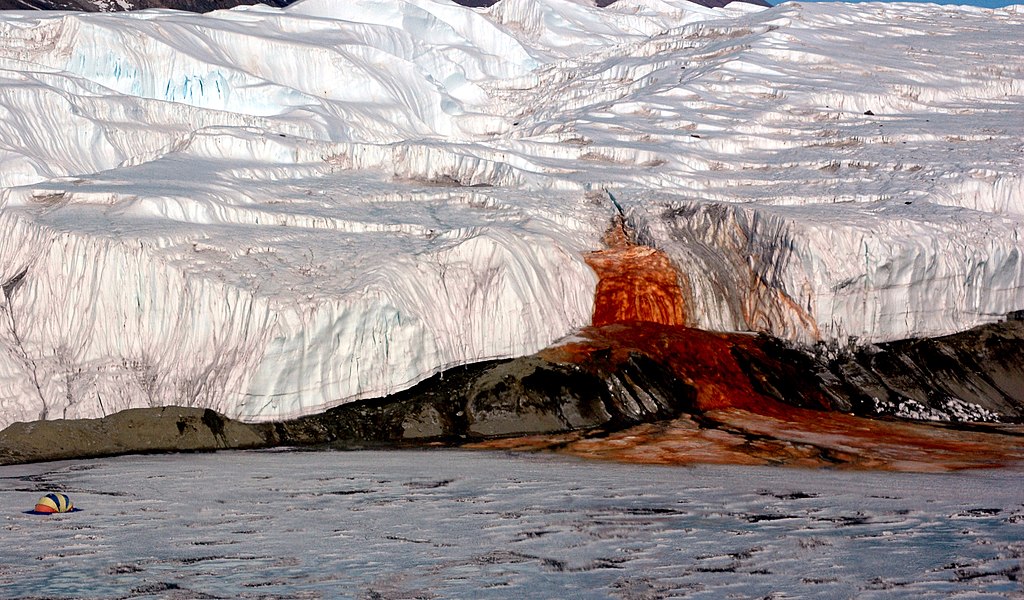
And then there are places that bleed:
The Blood Falls seeps from the end of the Taylor Glacier into Lake Bonney. The tent at left provides a sense of scale for just how big the phenomenon is. Scientists believe a buried saltwater reservoir is partly responsible for the discoloration, which is a form of reduced iron.
In the frozen skin of Antarctica, from the heart of the Taylor Glacier, seeps a phenomenon called Blood Falls, a five-story wound of iron-rich brine that stains the ice like a divine hemorrhage. The water is anoxic, hypersaline, and ancient. Trapped beneath the glacier for over a million years, untouched by sun or air. When it spills, it does not bring life it summons a testimony of entrapment. Inside that red cascade: no fish, no moss, no song. Only archae, blind, ferrous, and mute. They are not life as we know it. They are a vestige, a compromise. A flicker of endurance in a landscape that fundamentally does not care.
In the end, chemosynthesis is not a miracle. It is the residue of a planet that prefers silence, but occasionally leaks blood.
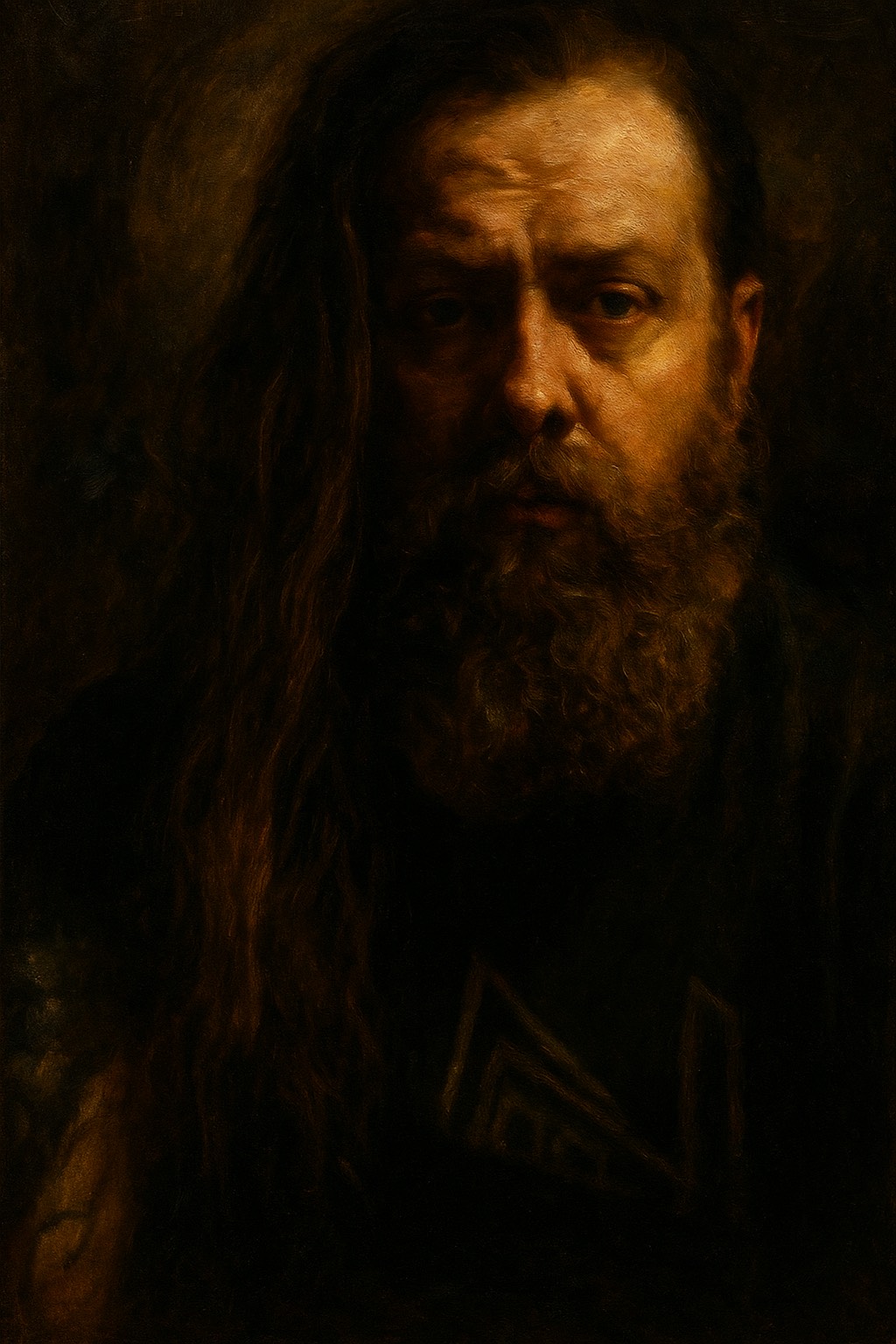
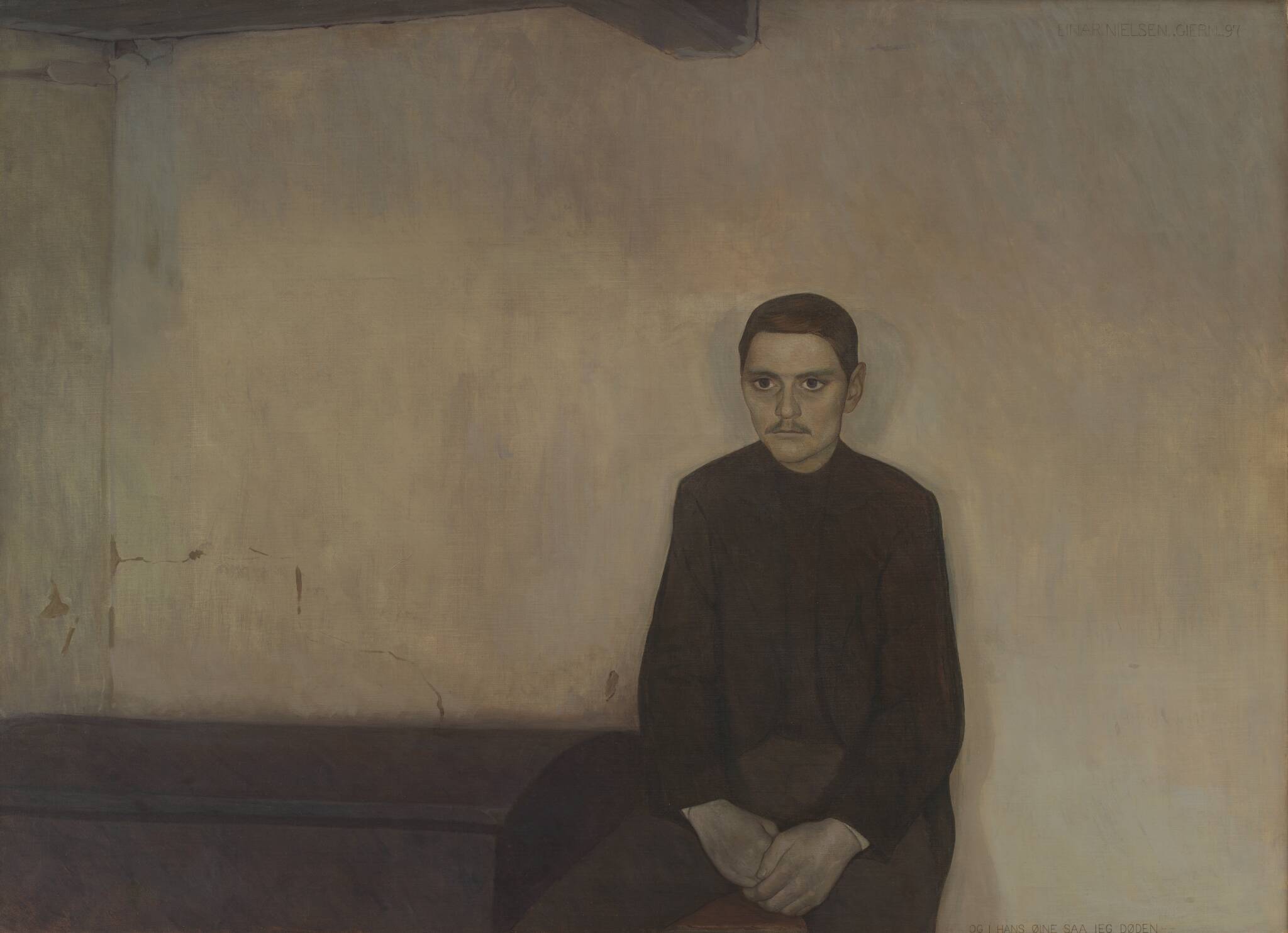
There is no movement in the painting. Only a hush that has forgotten sound. A man sits, not young, not old, simply undone. His hands rest in his lap like folded wings, long since stripped of flight. Around him, the air is thick with something unnamed, something that clings to the skin like humidity in a closed room. The walls are the color of waiting.
His face bears no wounds, but something inside him has ruptured. You can see it in the angle of the shoulders, the slope of the neck, the way the eyes do not meet yours, they look beyond you, into something after. Something under.
There are no flowers in this room. No window. The light does not fall, it hovers grey and sour, like breath held too long. If there is God here, He is tired.
You sense that this man has outlived the season of being seen. He is no longer watched, only remembered by the room that holds him. The floorboards have memorized the rhythm of his pacing, the chair has memorized the shape of his retreat.
And the eyes, the eyes are not empty. They are full of stillness.
The kind of stillness that comes not from peace, but from having waited too long for anything to change. The kind of stillness that resembles death, but lingers.
He does not cry. He does not blink. He remains.
And in his eyes, you see it not a corpse, but the invitation to become one.
Ejnar Nielsen – Og i hans øjne så jeg døden – 1897
Sou o plural que afogou tentando nadar no singular, um labirinto de carne contra o solo, um feto ornamental na lata de lixo do mundo.
Vivo pela dádiva do não ser, mas o dia mostra suas presas e dilacera cada esperança acumulada como lixo até o teto. Minha mente é um domicílio insalubre onde nenhum pensamento respira sem apodrecer.
Tento auscultar o ventre da morte mas ela me devolve um espelho um raio-x clandestino, onde vidas ofegam dentro de mim, como raízes de um deus ruborizado pela vergonha de nos ter imaginado.
Meus frutos são pútridos. Colhi cada um no pomar de Dante, diante do púlpito pedregoso, entre serpentes que pregam com as mandíbulas.
A escritura se fecha dentro do outro revelando anseios nodosos, alimentando-se de terrores triviais, medos com dentes, palavras que morrem no instante em que são ditas.
Não quero te dizer nada. Minha fragilidade se recusa às circunvoluções sangrentas. O mundo está preso comigo, respirando o mesmo lodo glandular, observando cadáveres inchados sorrindo sob o sol que os consome.
Sou um erro da minha própria imaginação, um acumulador de ruína, um coração que ainda bate, mas não ecoa mais em lugar algum.
É fácil me emaranhar nos fios da minha dor, difícil é entrar no abismo do outro sem me perder inteiro.
Mesmo que decifre minhas palavras, elas partem de uma realidade hierática, perdida, oculta, irreparável. Não significam. Sangram.
E no fim, novamente me pergunto: qual o propósito de continuar vivo, sabendo que tudo o que amamos será apagado?
Talvez sejamos só isso: um epitáfio em algum Araçá, ou apenas cinzas, deitadas com resignação sobre a areia negra do esquecimento.
“All my griefs to this are folly; Naught so damned as melancholy.” – Robert Burton
Melancholy ancient, thick, and bitter as tar is no mere sorrow. It is the distillation of knowing too much, feeling too deeply, and surviving it nonetheless. John Donne, cloaked in shadows darker than clerical robes, penned Biathanatos not as a mere provocation but as confession, whispered beneath the crushing weight of despair. He dared ask if the soul’s last breath might, under certain stars, be sacred.
In early modern England, suicide was named felo de se literally, a felon against oneself. A legal phrase, devoid of compassion, branding the victim criminal, the corpse disgraced, impaled at crossroads, denied holy burial. A death by one’s own hand stripped estates, blackened names, and condemned souls to perpetual wandering.
Donne, irreverent theologian, suggested a scandalous mercy: perhaps not every self-homicide is sinful. He raised Christ Himself as a paradoxical figure, the divine suicide, choosing the cross knowingly. This thought was dangerous, heretical, whispered only in ink never meant for daylight.
Two decades later, Robert Burton’s Anatomy of Melancholy dissected this darkness with scholarly precision. He saw melancholy as the scholar’s disease, the philosopher’s poison, too much thinking corroding the mind. Burton chronicled black bile as more than a humor; it was cosmic ink staining every great thinker, poet, and saint.
Black bile fuels insight yet poisons the will. It gifts clarity, yet often tempts one toward ropes, blades, and quiet escapes. Burton documented the affliction thoroughly, a guidebook of despair. He did not condone suicide, but neither did he dismiss its gravity. He understood.
Historian Georges Minois, in his profound work History of Suicide: Voluntary Death in the West, adds depth to this discourse, observing that suicide, throughout history, has oscillated between condemnation and reverence, tragedy and nobility. Minois highlights how societal responses reflect deep anxieties about autonomy, suffering, and religious control. Suicide emerges as the ultimate act of personal rebellion, both feared and occasionally venerated, forcing society to confront uncomfortable truths about freedom, meaning, and human suffering.
And therein lies the dark covenant, the silent pact: the melancholic does not yearn for death out of mere sorrow, but from exhaustion of understanding, from the unbearable weight of seeing beyond illusions. Donne’s forbidden manuscript and Burton’s meticulous anatomy meet here in this shadowed understanding that the gravest sin might sometimes be the truest prayer.
This is not advocacy, nor a glorification, but acknowledgment of the depth that black bile carves into souls who think and feel too deeply. Donne, Burton, and Minois confront us with a troubling empathy: that the choice between life and death can emerge not from weakness, but from too clear a vision of existence’s harsh truths.
In a world determined to judge swiftly and harshly, these three voices whisper a hesitant mercy, allowing those haunted by black bile a fragile solace that perhaps the longing for silence, for final stillness, might not always be a betrayal, but a profoundly human plea.
I am Zenosyne, not by birth, but by erosion. I did not seek this name, it grew on me like mold in a sealed room. I Fought the seconds, i begged the clock to slow down, but the faster i ran the more i understood. There’s no finish line.
Time didn’t pass me by, it bled through me. I watched my memories blur, their edges fraying into screams. I felt my hand reaching to people i hadn’t lost yet, but already mourned. I loved in reverse. I forgot before i could feel.
Now i no longer move through time. Time moves through me, like fire consuming dry leaves. Like sorrou through bones.
I am Zenosyne and the hush after breath. I am the weight of a thousand deaths, pilling corpses on the pyre of a godless dream.
And Still, there’s nothing i can do because this is no punishment, it is understanding. It is acceptance. I am what remains when there’s no more. Now.
I feel a tearing pain through my body. It’s as if my bones would break at any moment. I can’t find the strength to perform any daily task. I feel an emptiness that is growing and filling up every space in my body until I lose consciousness of myself. The days blur together. I don’t remember the last time I felt anything at all. It’s as if a cloud has settled on my mind, a thick haze that blunts every emotion, every thought. Even in the rare moments when I look outside, I see no difference between the morning and the evening. I am caught in some endless grey, devoid of purpose or joy. But perhaps I’ve never really known joy, not truly. I am numb. Nothing holds meaning anymore. Not the sun, not the stars, not even the air that I breathe. What is the point of any of this? Is it even real?
Nihilistic Contentment
I wonder if it’s all just a farce. A cruel joke, played by the universe. If everything is meaningless, if existence is nothing but a brief and futile blip in an endless void, then why bother? Why bother with anything? Nothing matters. Not the relationships I had, not the work I did, not the things I thought I cared about. Everything, every single thing I’ve ever known, is destined to dissolve into nothingness. A mere flicker in time. If I were to disappear, would it even matter? Maybe this is how it should be. An existence so insignificant, it should never have been.
Delirium Mortems
I am fading away, slipping between worlds. I can feel it now, the strange sensation that I am no longer fully here. I catch glimpses of myself in mirrors, if that is even my reflection. The face staring back at me is distant, as if it belongs to someone else, or perhaps no one at all. When I speak, my voice sounds muffled, as though it is coming from a place I cannot reach. Am I still alive? I don’t know. I don’t feel alive. My thoughts are clouded, fragmented, like pieces of a puzzle that no longer fit together. I am untethered, drifting through a haze of fractured memories and sensations. The feeling I have is that at any moment a monster will come out of my skin. A monster tired of all this performance. Of all this vanity. Or could I be that monster? I walk down the street, and I can’t see the faces. All I see are evil presences, staring at me as I walk down the street. Or lurking in my house. They scream in a high-pitched voice: Look inside.
I can’t take it anymore. I’ll let it out.
Am I Dead?
Is this what death feels like? I don’t know. If I am dead, then why am I still thinking? Why can I still feel the weight of my body, even though it seems distant, as though it’s not really mine? I don’t feel hungry, I don’t feel thirsty. I don’t feel the need to perform any basic hygiene or survival activities. After all, I’m dead. My heart is no longer pumping blood through my body. My brain is a gray mass of memories that no longer exist. There is no pain, no finality, no release. Just this endless drift. And if I am dead, then what? Is this all that remains of me? A collection of half-formed thoughts, rattling in an empty mind? Or have I been cast into some hellish afterlife where the soul is tortured by the unbearable weight of its own futility? Perhaps death is not what I thought it was. Perhaps it is not an end, but a continuation an endless loop of despair. I’m watching my own body decay.
Decompose
Children of Death, destined to die. Never too young to be eaten by worms when it turns shit. We fight to hold on to what we know, but why? Why cling to this rotting shell of a body when it’s already crumbling from the inside out? It’s almost funny, isn’t it? The way we act like life’s some kind of precious thing, something to protect, to treasure. All this time, I’ve been dragging this corpse around like it’s worth something. But I know the truth now: it isn’t. I’m not alive. I’m just waiting for the worms to do their job.
It’s happening slowly, but it’s happening. My skin feels like paper, tearing at the edges. How long until it all just flakes off? How long until I’m nothing but a pile of dust and maggots, buried beneath the earth, forgotten like so many others? It’s not a matter of if; it’s when. And who cares when it happens? I certainly don’t. Maybe the worms will find me before I can get to them. Wouldn’t that be a nice change? They’ll probably get a good laugh out of it. They always do.
This flesh, this meat, it’s useless now. My heart keeps pumping, but it’s just a muscle playing an old song it’s too tired to sing. My lungs keep breathing, but for what? For whom? I don’t even remember why I’m still here. Every breath feels like a waste. Every movement, a joke. And yet, here I am, clinging to this flesh, like a kid clutching their toys, thinking they’re invincible. But I’m not invincible. No one is. Just look at me. Look at what’s happening. The body’s decaying. The mind’s decaying. Everything is decaying.
The question is: Why try holding on to what’ll be gone? The answer? I don’t have one. Maybe I’m just too tired to let go. Or maybe I’m already dead, and this is just some cruel, lingering afterthought. The worms will find me eventually. They always do.
Autophagic Commiseration
It’s the only thing left, isn’t it? Nothing else matters. Not the food they bring, not the way it smells, not the way it looks, because I’m dead. I know it. I can feel it deep inside, like a truth that’s too heavy to carry. So, if I’m dead, then what’s the point of eating, of pretending? It’s all pointless, all futile. I don’t need them anymore. I don’t need anything. I’ve already slipped past the point of no return. I can’t remember the last time I ate real food, real life. What does it matter? I’m dead. Maybe this is what it’s like to be dead, just… drifting. My body is nothing now but a shell, and it’s falling apart, like dust, like rotting wood. So why not? Why not consume it? I can feel the flesh tearing, the skin flaking off, but it’s mine, it’s me, it’s all I have left. I press my fingers into the soft, spongy flesh of my arm my arm, yes until it breaks open, until I can tear it off. It’s warm. Why is it still warm? No, it doesn’t matter. Nothing matters. I’m already dead. There’s nothing wrong with this, is there? It’s all just… meaningless. I bite into it, the taste of my own flesh. It’s bitter. It’s salty. It tastes like despair, like death, like I’ve always known it would. What else is there? I’m already gone. It’s only the body left, a carcass rotting, but it doesn’t even feel like I’m eating anymore. I’m just… dissolving. I’m nothing. A hollow thing that still walks, still breathes, still hurts. It’s all a joke. My own flesh, the only thing I can consume, and even that is decaying. I can feel it, I can feel it rot in my stomach, in my soul. I don’t care. I can’t care. There’s nothing left to care about. Just this empty shell of a body, this empty shell of a life. I’m dead, but I’m still here. And I will keep eating, I will keep tearing into myself, until there’s nothing left, nothing to hold onto. Until there’s nothing left to rot away.
The Observer
The door was slightly ajar. I hadn’t meant to look in, hadn’t wanted to see it, but there it was, impossible to ignore. The stench hit first, like a rotten carcass that had been left to fester in the heat for too long, an overwhelming, suffocating odor that clawed at my throat and made my stomach churn. My eyes watered. I pushed the door open further, the hinges creaking like some old, tortured thing. I thought I was going to be sick. And then I saw him.
He was hunched over, his body twisted in a grotesque imitation of human form, crouched like some animal, some feral thing. His skin if you could even call it that anymore hung from his bones in tattered strips, a sickly, yellowish hue, as though it was melting off, barely clinging to the jagged protrusions beneath. His fingers, swollen and crooked, dug into his own flesh, pulling it free with unnatural force, as though he were trying to tear his body apart from the inside.
I froze. My breath caught in my throat as I watched him tear at himself, gnashing his teeth into the raw, exposed muscle. The sickening sound of it flesh rending, teeth grinding against bone, the wet squelch of his mouth full of meat was unbearable. It made my stomach lurch, but I couldn’t look away.
He was eating himself. Eating his own rotting flesh, ripping off strips of skin and sinew with his bare hands, swallowing it, chewing like it was the most natural thing in the world. Blood oozed from the gaping wounds, dripping down his body, pooling on the floor beneath him like some twisted, red puddle. The room was slick with it, thick and coagulating, the stench of decay so powerful it felt like it was suffocating me, wrapping itself around my lungs.
I stepped back, but the sound of my own movement seemed to draw his attention. His head snapped up, his eyes wide and empty, blackened orbs that glistened with a grotesque, feverish intensity. There was no recognition in them, only a void, vacant stare. His mouth was coated with blood, chunks of his own flesh still dangling from his lips. The corners of his mouth twitched, as though he wanted to speak, but no words came. Only a low, guttural growl, like an animal in pain.
“Please,” I whispered, my voice trembling. “Please stop.”
He didn’t hear me. Or maybe he did, but he couldn’t understand. His hands went back to tearing at his own body, ripping at the sinew, swallowing it whole. The sound of his jaws cracking as he chewed through the raw flesh was maddening. I wanted to scream, to run, to do something, but my legs felt like stone. I was frozen, rooted to the spot, watching as he consumed himself, as he destroyed what was left of his humanity.
There was nothing left of him now. Just a mangled, bleeding thing that was slowly fading into the madness of his own delusion. He wasn’t a man anymore. He was just… death. He had become death, chewing and swallowing, his own body betraying him in the most grotesque way imaginable.
And I could still hear the sound of it. The sound of him tearing himself apart. The sound of flesh being consumed. The sound of a man, or what had once been a man, slipping into a rotten abyss.
The universe lies gasping, A bleeding patient upon eternity’s table. Stars, malignant growths, Nebulae pulsate like infected organs, Space-time shredded open wounds. Dark surgeons arrive, Wielding scalpels forged from quantum void, Gravitational sutures threaded through black silk. Their hands, unseen and precise, Begin the futile reconnection, Stitching galaxies, closing cosmic veins. But healing births disaster, Seams burst violently, Reality splits, flesh-like, Gaping mouths of oblivion yawn wide, Black holes exposed infected sores, Spewing forth the nameless horrors, creatures older than the universe itself.
Primordial evil, lurking parasites, Dragged from the hidden chambers of nonexistence, Infesting matter, corrupting life. Their whispers echo, nihilistic psalms, Reducing hope to stellar ashes. An endless cycle of torment, Each suture births fresh atrocity, Each anastomosis deepens wounds, Until all that’s left is cosmic rot, A celestial body collapsing in on itself, Revealing the ultimate truth: Existence, merely prolonged decay, Suffering stitched into the universe’s fabric, Healing is illusion; pain is eternity, Nullanastomosis, Forever binding life to inevitable doom.






 Black Holes Whispering in Tongues